







What if the real question weren't “Where should I live?” but “How do you want to live?”
Many seniors are reluctant to make this decision, seeing it as a concession to old age. It’s understandable. A home of one’s own represents a whole life: habits, memories, and a freedom that one doesn’t want to give up.
But the question deserves to be framed differently. Not “Should I leave?” but “What do I want for the next twenty years?”
At Casa Barbara, we don’t just sell a home. We offer a lifestyle. And we sincerely believe that the right choice is the one that suits you—whatever that may be. So here’s an honest comparison, point by point.
Freedom: Greater Than We Think in Residential Settings
The first instinct is to associate senior living with a loss of independence. It’s a persistent misconception—and largely false.
A well-designed senior living community is not a nursing home. It’s a residential building that offers services, not restrictions. You come and go as you please, have guests over whenever you like, and organize your days however you see fit.
What’s the difference from a traditional apartment? You’re no longer the only one responsible for day-to-day management. Maintenance, cleaning of common areas, security… it’s all taken care of. What some call a “loss of freedom,” others call “freedom from chores.”
See also: What Is a Senior Living Community? A Complete Guide
Safety: the factor that changes everything after age 75
A typical apartment offers complete independence. But it offers nothing when you fall asleep at 3 a.m., when a power outage lasts four days, or when the flu leaves you bedridden without anyone knowing.
According to the French National Authority for HealthFalls are the leading cause of accidental death among people aged 65 and older. Living alone remains the most underestimated risk factor.
In a senior living community, someone is always there for you. Not in a medical sense—but in a human sense. Someone checks in on you every day. Someone notices if you haven’t come down for lunch. This invisible safety net is worth its weight in gold—for you, and often even more so for your loved ones.
See also: Falls and Isolation: The Overlooked Risks of Home Care
Social connection: what walls cannot provide
Loneliness among older adults is a public health issue. The WHO lists it as a major risk factor: it is said to increase the risk of dementia by 50% and, in terms of its impact on health, is equivalent to smoking 15 cigarettes a day.
In a typical apartment building, social connections are something you have to build yourself. It’s possible—but it takes energy, a local network, and good health. Over the years, that capital erodes.
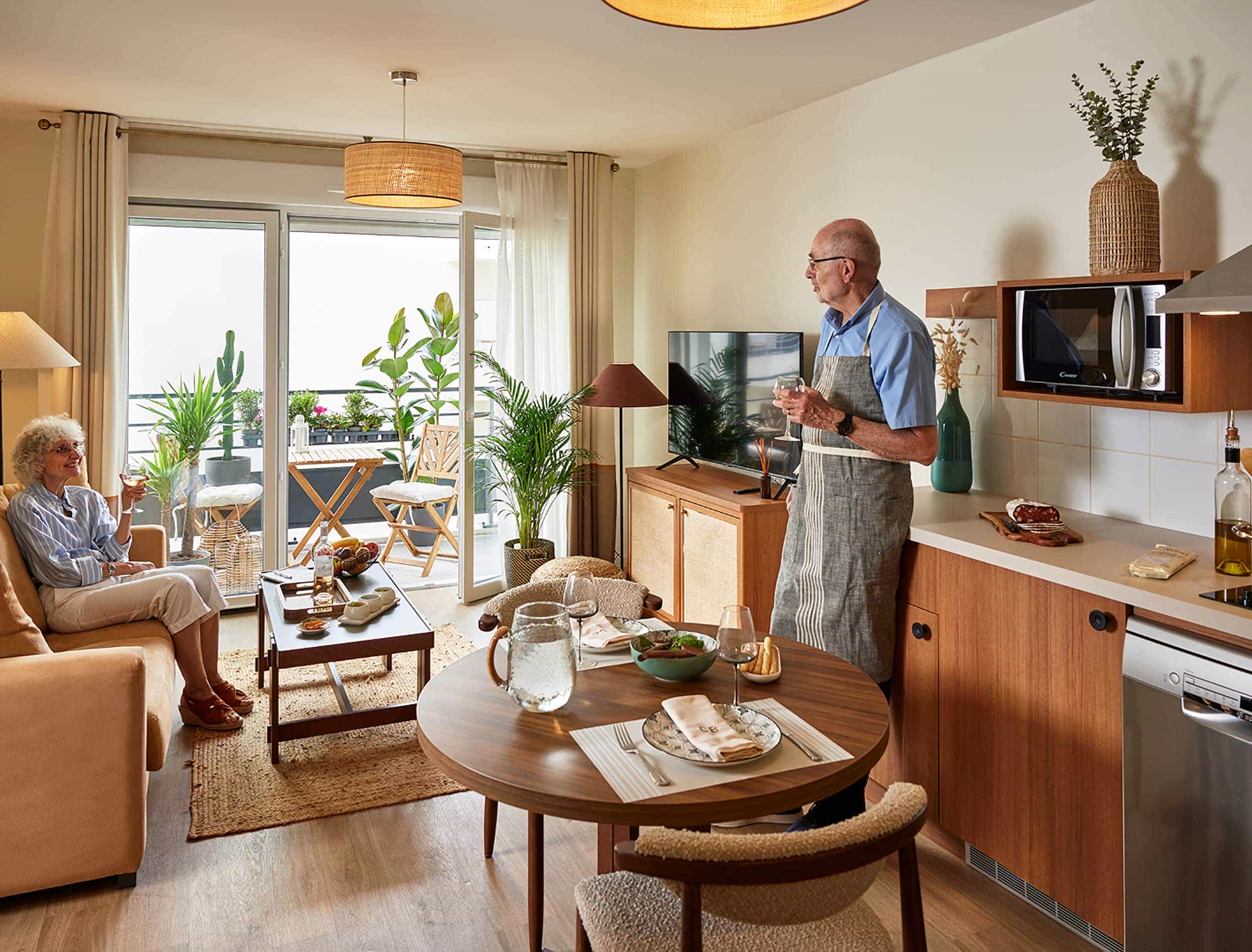
In a senior living community, social connections are built into the fabric of daily life. They don’t depend on luck or individual initiative. People come together naturally: at breakfast, during a workshop, or over a drink on the terrace. The community is already there—all you have to do is join in.
At Casa Barbara, that’s exactly what we’ve built: a community of people who have chosen to grow old together, in good spirits and without a dull moment.
See also: Staying Socially Active After 60: A Complete Guide
Cost: an equation that shouldn't be oversimplified
A traditional apartment seems cheaper. When it comes to rent, that’s often true. But that’s not the whole story.
You have to add up: rent or condominium fees, home modifications (grab bars, walk-in showers, intercoms, etc.), outsourced services (housekeeping, meal delivery, telephone assistance), enhanced health insurance, and the human cost—often unseen—that weighs on the children.
A senior living community with on-site services combines all of this into a clear, straightforward package. It’s not always cheaper per person, but it’s often easier to budget for—and, most importantly, there are no hidden costs.
To compare the two options, you need to compare the actual total costs, not the gross rent.
Everyday comfort: the little things that make a big difference
Fix a leaky faucet. Check on the boiler. Call an electrician. Take out the trash. Manage deliveries. In a typical apartment, these are everyday tasks—but they become obstacles as the years go by.
In a senior living community, these hassles disappear. Not because you’re treated like a child, but because the space has been designed so you don’t have to worry about them.
What do you gain in return? Time. Energy. A sense of lightness. Enough to focus on what really matters.
Adaptability: Thinking About Today and Tomorrow
A traditional apartment is a one-size-fits-all solution. If your health changes, you may have to move again—on short notice, without having planned for it.
A good senior living community is designed to grow with you. The spaces are adapted to your needs, the services are flexible, and the environment is safe. You won’t have to start all over again if your circumstances change.
This may be the most strategic consideration: choosing a living environment today that won’t force you to make another difficult choice five years from now.
What the science really says
The studies are consistent. A study published in The Gerontologist shows that older adults living in active social housing have significantly better cognitive outcomes at the five-year mark. INSERM confirms the protective role of a structured social environment against functional decline.
This isn't a sales pitch. It's epidemiology.
The real question: What gives you a sense of purpose?
There’s no wrong answer here. There’s just your answer.
Some people will continue to thrive in their apartments for another ten years. Others will discover, when they visit a retirement community, that they were unconsciously looking for exactly what’s being offered to them.
Our advice: don’t settle for the first option that comes along. Don’t stay in an apartment out of habit, or move into a residence out of fear. Visit. Compare. And make a thoughtful choice—for the next twenty years.
At Casa Barbara, we’re happy to welcome those who are still on the fence. Because a visit is worth more than a long sales pitch.
Join the tribe. #ForeverYoung
🏠 Discover Casa Barbara — Book your free tour